
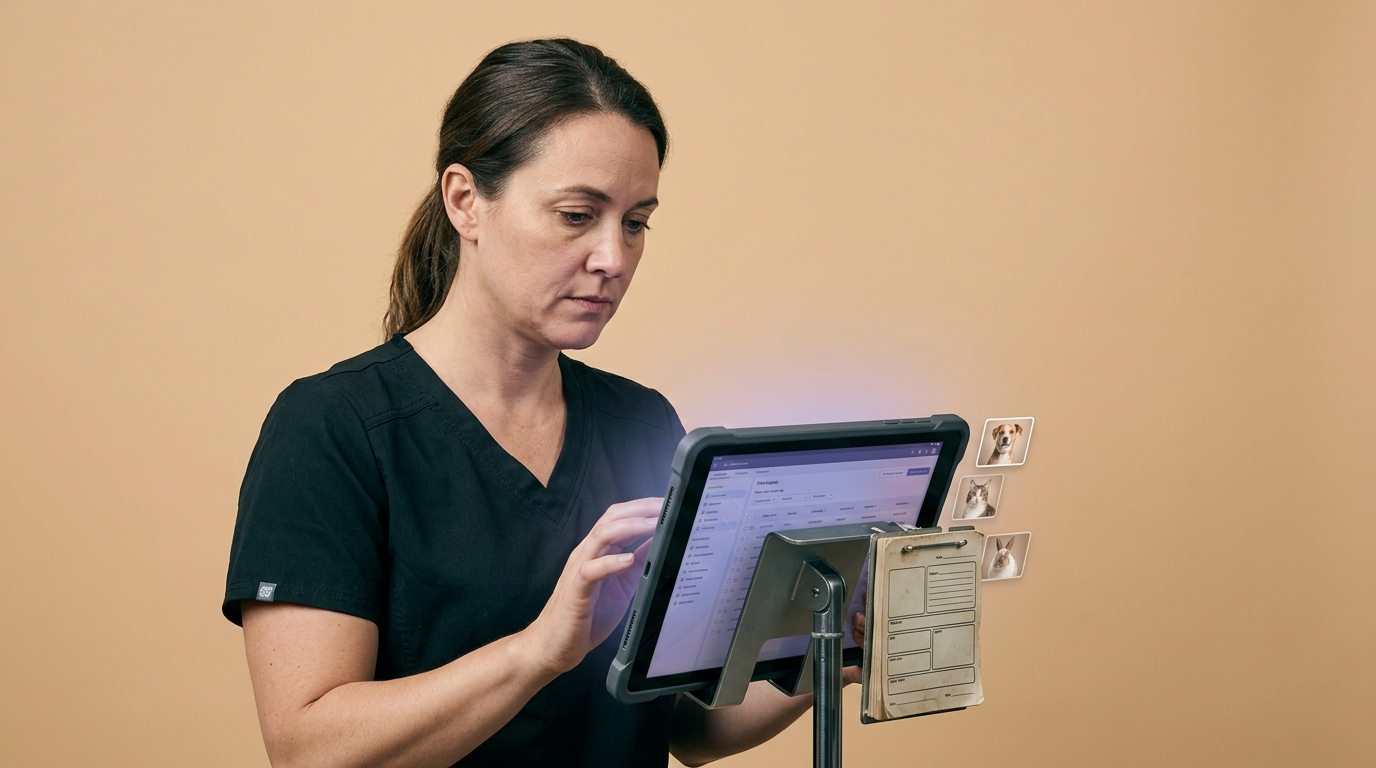
At 2am, Your PIMS Is Either Infrastructure or an Obstacle
Nobody demos software at 2am.
Demos happen at 10am on a Tuesday, with one patient, one clinician, one clean workflow, and a sales engineer who knows exactly which button comes next. Nothing arrives out of order. Nobody hands off mid-procedure. The estimate doesn't change three times in forty minutes.
Your floor is not that. Your floor is a GDV coming through the door while a hit-by-car is being stabilized in treatment and an owner in the lobby is deciding whether they can afford the second set of radiographs. That is the shift your software actually has to survive — and it's the shift almost no PIMS is designed for.
This piece is about naming that gap precisely. Not "the system is slow." Not "it's a nightmare at night." Precise vocabulary, so you can put it in an RFP, say it out loud in a vendor call, and stop losing the argument to people who have never worked a Saturday overnight.
The gap is between demo conditions and real conditions
Demo conditions assume:
- One patient at a time, worked start to finish.
- One clinician owning the record from intake to discharge.
- A plan that doesn't change after it's approved.
- A workstation you sit down at.
- Time to type.
Real emergency conditions assume none of that. Every one of those assumptions is a place where the software either disappears into the background — infrastructure — or steps in front of the work — an obstacle.
Here are the four moments where the difference shows up.
Moment one: triage reordering
The waiting room is not a queue. It's a ranking that changes.
A stable-looking vomiting dog becomes your most urgent patient when the temperature and the abdominal palpation come back wrong. The cat you triaged as red improves on flow-by. The order you set at 11pm is not the order you're working at 11:20pm, and it changes again when the ambulance-transfer call comes in.
A PIMS built for appointments treats the day as a schedule — slots, in order, one per doctor. So your team keeps the real triage list somewhere else: a whiteboard, a shared doc, a photo of the whiteboard sent to the doctor who just came on. The system has a list. Nobody trusts it. That is the definition of an obstacle: software that is present but not authoritative.
The vocabulary: the record has to be reorderable at the pace of triage, and the reordered state has to be the one everyone sees. If the whiteboard is the source of truth, your PIMS is decoration.
Moment two: the mid-case handoff
Shift change at 2am is the highest-risk fifteen minutes in your building.
The incoming doctor needs to know what was given, when, at what dose, what the owner was told, what the owner agreed to pay for, and what the plan is if the pressures don't come up. In a system that works, they read the record. In a system that doesn't, they get a verbal handoff, because the record is forty minutes behind the patient.
The record falls behind for a specific reason: charting is a separate act from treating. If entering a treatment means walking to a workstation, logging in, finding the patient, and typing, then during a busy stretch it doesn't happen. It happens later, from memory, in a batch — which is exactly how doses drift and "I told the owner X" becomes contested.
The vocabulary: time-to-entry. Not how many fields the system has, but how many seconds between the thing happening and the thing being in the chart, from wherever the clinician is standing. If time-to-entry is measured in walks-across-the-building, your handoffs will be verbal forever.
Moment three: the revised estimate
Emergency medicine is medicine plus a live financial conversation, held with someone in the worst hour of their year.
You quote a range. The bloodwork changes it. The owner declines the ultrasound and accepts hospitalization. Then their card declines, and their daughter calls back with a different card and a different ceiling. Meanwhile the patient's needs haven't paused for the paperwork.
Where this breaks in most systems: the estimate lives in a different place than the treatment plan, which lives in a different place than the invoice. Revise one, and someone re-keys the other two — usually a CSR, usually at the desk, usually while three people are waiting. The gaps between those three documents are where you lose money, and where an owner later says "nobody told me it would be that."
The vocabulary: estimate, plan and invoice should be one object viewed three ways, not three documents kept in sync by a human. When they're three documents, revision is a re-entry task, and re-entry tasks are the first thing skipped when it's busy.
Moment four: the doctor who isn't in the building
The specialist on call. The medical director being phoned at home. The relief doctor who's covering a second site tonight.
They're being asked to make a decision about a patient they can't see, using a record they can't reach — so they reach it through a phone call and a description. Every clinical decision made from a verbal summary instead of the actual record is a decision made with the resolution turned down.
If getting into your PIMS from outside the building requires a VPN, a remote-desktop session, a laptop that isn't in the car, or a call to whoever has the server credentials, then remote access exists on paper and not at 2am.
The vocabulary: device-agnostic, browser-based access from anywhere, at full function. Not read-only. Not a stripped mobile view. The same record, doing the same things.
What "infrastructure" actually means here
Infrastructure is the stuff you stop noticing. Lights. Oxygen lines. Working suction. You only ever notice it when it fails.
Software becomes infrastructure when three things are true:
- It's where the truth lives. Nobody maintains a parallel record on a whiteboard, a group chat, or a legal pad, because the system is faster than the workaround.
- It's reachable from where the work happens. Treatment area, exam room, lobby desk, parking lot, the doctor's kitchen at home — same record, any device, no ceremony.
- It survives revision. Reordering, reassigning, re-estimating and handing off are normal operations, not exception handling.
Most legacy PIMS fail all three at once, and they fail them for the same structural reason: they were built as on-premise, appointment-shaped, workstation-bound systems. That architecture is fine for a two-doctor GP practice running a book of scheduled visits. It is actively hostile to a floor where the order changes, the owner changes their mind, and the doctor changes at 2am.
That's the claim, plainly: cloud-native, device-agnostic access is not a convenience feature for emergency medicine. It's the thing that lets the record move at the pace of the floor. When the chart is a browser tab that opens on whatever's in your hand, entering a treatment costs seconds instead of a walk, the estimate updates in front of the owner, the incoming doctor reads instead of listens, and the medical director at home sees what's actually in the patient rather than what someone remembers to say.
And when the record keeps up with the floor, you stop paying the tax you're paying now: rework, re-keying, reconstructed notes, disputed estimates, and doctors finishing their charts at home after a fourteen-hour shift.
How to use this in a vendor conversation
You'll get a better demo if you take control of the conditions. Some things to ask for, in these words:
- "Show me a triage list being reordered." Not the appointment schedule. The live ranking, changing, with everyone seeing the change.
- "Show me a mid-case handoff." Doctor A stops, Doctor B picks up. What does B see without asking A anything?
- "Show me an estimate revised twice." Once because the diagnostics changed the plan, once because the owner declined a line. What has to be re-keyed?
- "Show me this on a phone, on hospital wifi, signed in fresh." Not on your laptop with your session already open.
- "Show me what a doctor at home sees." Full record, no VPN, no remote desktop.
- "Show me treatment entry from the treatment area." Count the seconds and the steps out loud.
If a vendor can only show you the 10am Tuesday version, you've learned something useful.
The point
Your team is smart, and smart teams route around obstacles. That's why the workarounds exist — the whiteboard, the group text, the sticky note on the cage door, the "I'll chart it after." Those aren't discipline problems. They're the visible evidence that the software is slower than the shift.
The goal isn't a PIMS your team likes. It's a PIMS your team stops thinking about — one that's simply there, like the oxygen line, holding the record steady while the floor moves.
At 10am on a Tuesday, every system looks like infrastructure. At 2am, you find out.
Part of the series "Software for the Worst Shift of the Week" — emergency and urgent care workflows expose everything a PIMS gets wrong about pace, handoffs and triage. Next in the series: [add next post title].
If you want to see the 2am version rather than the demo version, we'd rather show you the handoff than tell you about it. [Book a walkthrough with your own scenarios.]